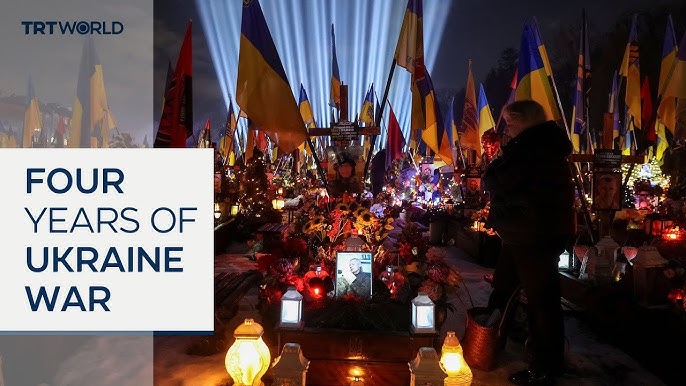
Four Years In: The War That Rewrote the Rules of Modern Conflict
As Ukraine marks the fourth anniversary of Russia's full-scale invasion, the conflict has become something no one predicted — a grinding war of attrition that has fundamentally altered how nations fight, ally, and think about security.
Four years ago today, most Western intelligence agencies predicted Kyiv would fall within 72 hours. They were wrong about almost everything. The Ukrainian capital still stands. President Zelenskyy — the former comedian whom many expected to flee — has become the defining wartime leader of his generation. And Russia, which launched what it called a "special military operation" expecting swift capitulation, finds itself locked in the longest major European conflict since World War II. But survival is not victory, and the anniversary mood in Kyiv is one of exhausted determination rather than celebration. The numbers paint a picture of staggering human cost. The United Nations has documented over 12,000 civilian deaths, though the actual figure is almost certainly higher. Millions have been displaced. Entire cities — Mariupol, Bakhmut, parts of Kharkiv — exist now only as names on maps, their physical reality reduced to rubble. What makes this conflict historically significant extends beyond the casualties. Ukraine has become the world's largest laboratory for next-generation warfare. Cheap consumer drones, modified with 3D-printed components, have proven as decisive as tanks that cost millions. AI-assisted targeting systems process battlefield data in real time. Electronic warfare has evolved from a supporting capability to a primary weapon system. For Canada, the war's lessons are uncomfortably relevant. The Canadian Armed Forces have been studying Ukrainian tactics intensively, recognizing that the assumptions underlying Western military planning — air superiority, technological dominance, short decisive campaigns — have been challenged by a conflict that rewards adaptability, industrial capacity, and societal resilience. The diplomatic landscape has frozen as thoroughly as the frontlines. Peace negotiations remain stalled, with both sides holding positions that the other considers non-negotiable. Russia demands recognition of its territorial gains. Ukraine insists on full sovereignty within its internationally recognized borders. The gap between these positions has not narrowed in four years. European leaders gathered in Paris today to mark the anniversary, with French President Macron calling the invasion a "triple failure" for Russia — military, diplomatic, and moral. But behind the solidarity statements, European unity is showing strain. Defense spending commitments remain unmet by several NATO members. Sanctions enforcement has gaps. And the question of how long Western publics will sustain support for a conflict with no visible end hangs over every policy discussion. Zelenskyy's anniversary address struck a tone that was defiant but notably more pragmatic than in previous years. The language of total victory has given way to the language of just peace. Whether that shift reflects political realism or strategic repositioning will become clearer in the months ahead. What is already clear is that this war has permanently altered the European security architecture. The idea that major land wars in Europe were relics of the past has been shattered. And the world that emerges when the fighting finally stops will look nothing like the one that existed on February 23, 2022.
This story is developing and will be updated as more information becomes available. Stay tuned to Canada Day for the latest updates on this and other breaking news stories.